Human nature has a long memory for machines and a surprisingly short one for the people behind them. We remember the technology, but less often the researchers, engineers, and visionaries, many of them women, who built it.
For International Women’s Day and this year’s theme, Give to Gain, we’re highlighting women whose ideas shaped the technical foundations of the music industry we know today.
For those of us working in this space, their stories matter for a simple reason. They remind us that women have always been part of building these systems. They’ve also given us role models to look up to and a reason to keep making space for the generations to come.
So here’s a small technical alphabet: 26 women whose ideas now live somewhere inside the Music OS, with the honest admission that this list could, and probably should, have been much longer.
A is for Ada Lovelace
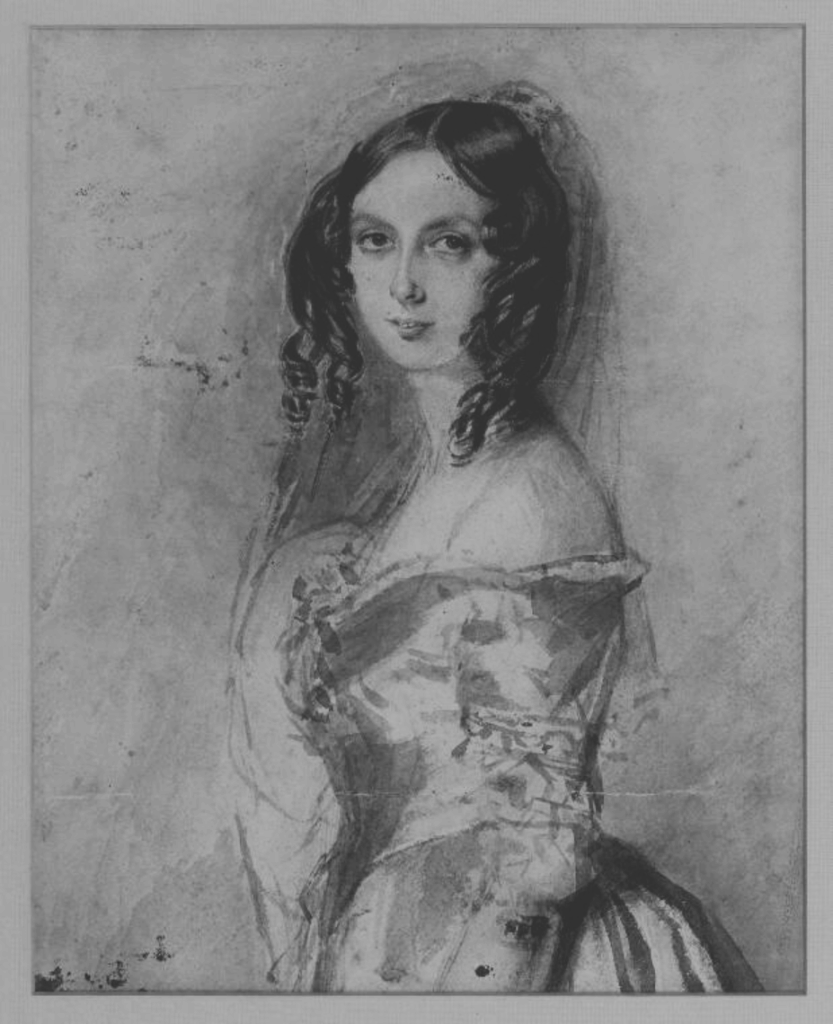
Born in London in 1815, Ada Lovelace wrote the first published algorithm intended for a computing machine while annotating Charles Babbage’s Analytical Engine in 1843.
In her famous “Note G”, she described how the machine could manipulate symbols according to rules rather than simply perform arithmetic.
Lovelace also observed that if musical parameters such as pitch or harmony could be represented numerically, the machine could process them.
The Analytical Engine itself was designed with punch card input, a processing unit called the mill, and a memory system known as the store, the essential architecture of a programmable computer.
Her notes introduced the idea that computational machines could generate structured musical material, anticipating algorithmic composition long before digital computers existed.
B is for Bebe Barron
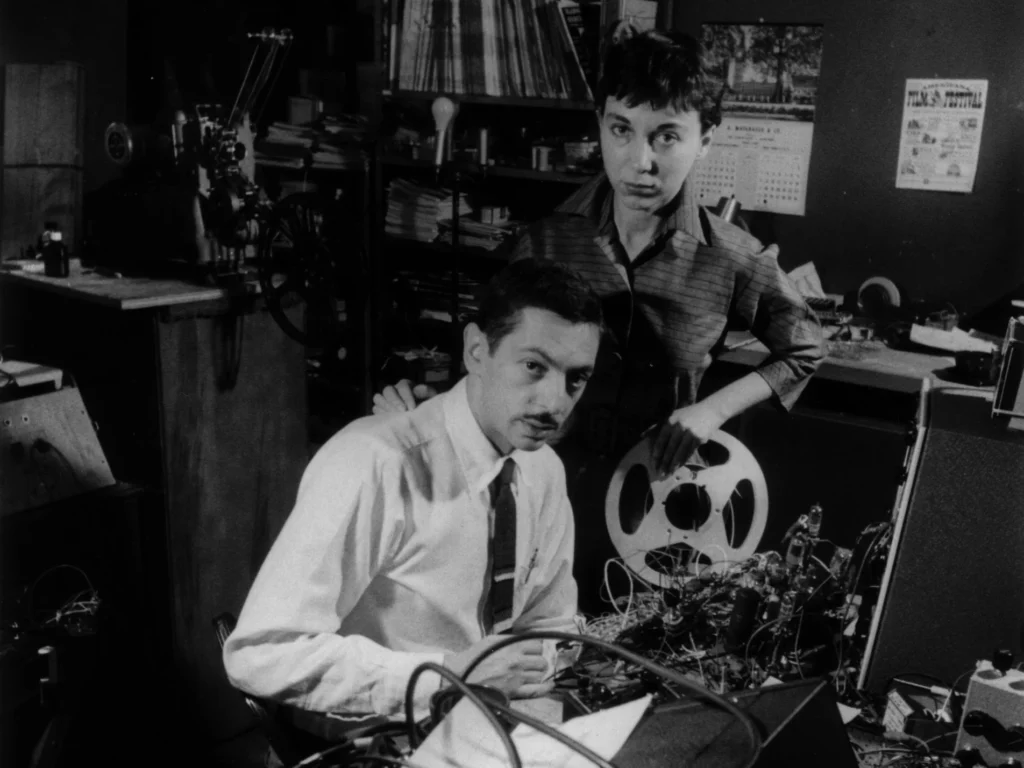
Bebe Barron helped create the first entirely electronic film score for Forbidden Planet in 1956.
Born in Minneapolis in 1925, she later built custom electronic circuits in New York inspired by Norbert Wiener’s cybernetics theory.
These circuits used vacuum tube oscillators configured in feedback networks.
The components were intentionally unstable, producing unpredictable electrical behaviour that generated unique sounds.
Because the circuits frequently overheated and failed, the audio had to be captured immediately using magnetic tape recorders.
Each circuit effectively produced a single sonic event before burning out.
Barron recorded, edited, and layered these signals to construct the film’s electronic soundtrack.
C is for Carol Krumhansl
Carol L. Krumhansl is a leading researcher in music cognition whose research applies computational modelling to musical perception. At Cornell University, she developed the probe tone method, an experimental framework for measuring how listeners perceive tonal relationships.
Participants hear a musical context followed by a single probe note and rate how well it fits. Statistical analysis of these responses produces tonal hierarchy profiles, now known as the Krumhansl–Kessler tonal profiles.
These profiles quantify the perceived stability of each pitch class within a key and have become fundamental to computational models of tonal music analysis.
D is for Daphne Oram
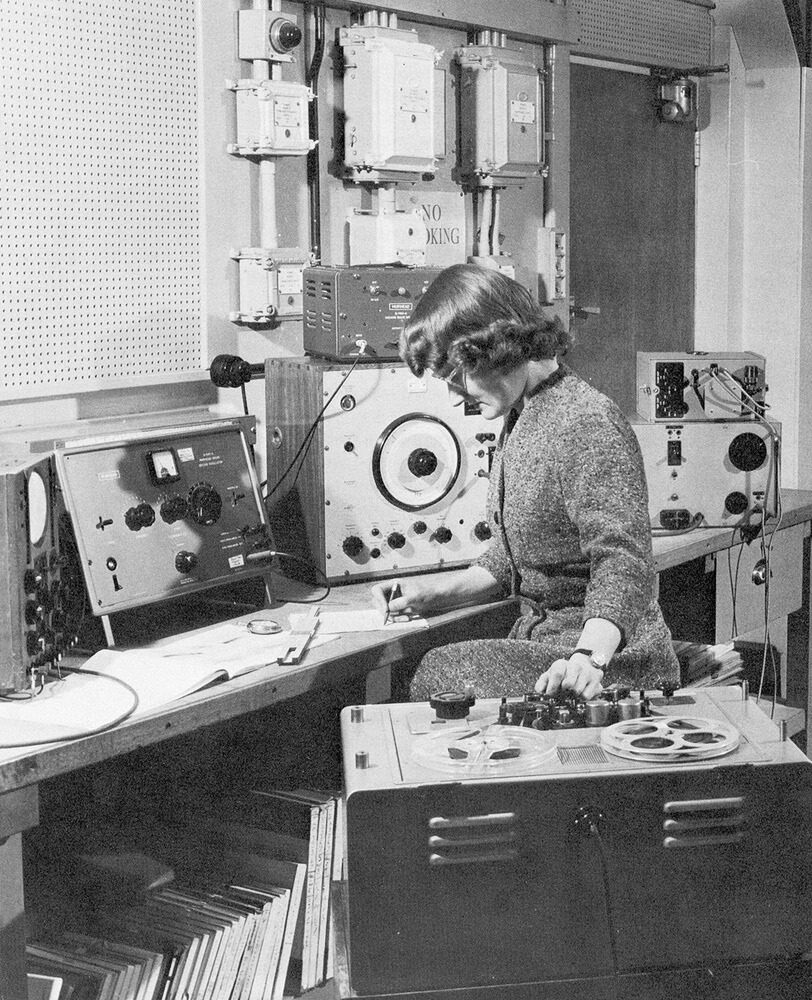
Daphne Oram was a composer and engineer who developed the Oramics system in the late 1950s.
The machine generated sound by converting graphical shapes into electrical audio signals.
Back then, composers drew patterns onto 35 millimetre film strips representing parameters such as pitch, amplitude, and timbre.
These drawings were scanned by photoelectric cells and converted into voltage signals that controlled oscillators and filters.
The system translated visual information into sound synthesis control data, an early precursor to graphical audio interfaces and automated sound control environments.
E is for Elizabeth Cohen
Elizabeth Cohen is an acoustician known for her research in audio preservation, architectural acoustics, and recording technology. She served as the first female president of the Audio Engineering Society.
Her research focuses on the physical behaviour of sound in enclosed spaces, including reverberation time, diffusion, and absorption. These parameters are typically measured using impulse response testing, where a broadband signal such as a swept sine wave is played in a room and analysed.
Cohen has also contributed to technical workflows used by institutions such as the Library of Congress to digitise analogue recordings while preserving their spectral characteristics.
F is for Françoise Barrière
Françoise Barrière was a composer, editor, and one of the key organisers of electroacoustic music institutions. In 1970, she co-founded the Groupe de musique expérimentale de Bourges, later renamed the Institut International de Musique Électroacoustique de Bourges.
Through IMEB she helped establish studios dedicated to electronic sound creation, supported research into filtering and spatialisation, and promoted large loudspeaker diffusion systems used to project electroacoustic works in concert.
She also contributed to building the institutional framework that supported commissioning, archiving, and international dissemination of electroacoustic composition as studios transitioned from analogue to digital production.
G is for Sophie Germain
Born in Paris in 1776, Sophie Germain was a mathematician whose research on elasticity helped explain how surfaces vibrate.
She studied the behaviour of thin elastic plates and the standing wave patterns that form when they resonate under mechanical excitation. These principles underpin much of acoustic engineering.
The same physics governs how vibrating diaphragms behave inside today’s microphones, loudspeakers, and headphones, devices that convert mechanical vibration into electrical signals and back again.
H is for Hedy Lamarr

Also known as a Hollywood actor, Hedy Lamarr co-invented a secure communication system based on frequency-hopping spread-spectrum technology in 1941 with composer George Antheil.
Their design synchronised transmitter and receiver frequencies using a mechanism inspired by player piano rolls.
Both devices switched frequencies simultaneously according to a predefined pattern, preventing interception or jamming.
Although originally developed for military communications, the same principle is used in modern wireless technologies, including Bluetooth and Wi-Fi.
I is for Jean Eichelberger Ivey
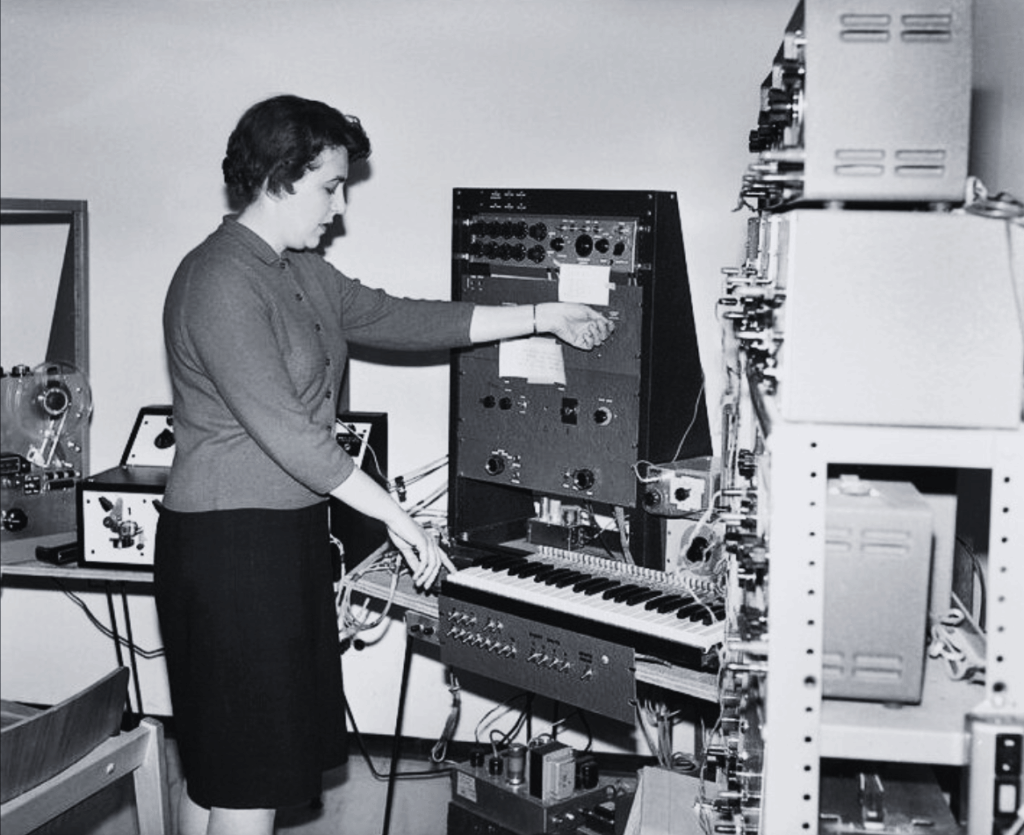
Jean Eichelberger Ivey was a studio architect and one of the early builders of electronic music infrastructure in the United States.
In 1969, she founded the Peabody Electronic Music Studio, designing the lab’s audio architecture herself.
The studio integrated modular synthesisers, magnetic tape systems, and patchable signal routing.
This environment allowed composers to experiment with voltage-controlled synthesis and electronic signal processing within an academic setting.
J is for Joan Miller
Joan Miller was a computer programmer at Bell Labs in the 1960s who worked with Max Mathews on the development of MUSIC IV. Earlier versions of the MUSIC system produced the first computer-generated musical sounds in 1957, and later enabled the first computer to sing.
MUSIC IV expanded the approach with a modular architecture in which digital instruments were built from signal processing elements such as oscillators, filters, and envelope generators.
This architecture became the conceptual foundation for modern digital synthesis software and computer-based audio engines.
K is for Karen Collins
Karen Collins is a researcher and composer whose work helped define the technical foundations of video game audio as an academic field. Her research examines how music and sound function inside interactive systems, where audio is controlled through event triggers, parameter mapping, and real-time processing rather than fixed on a linear timeline.
In game environments, music is often built from loops, stems, and one-shot cues, then managed through adaptive audio engines. These engines read game-state data and use techniques such as horizontal resequencing, vertical re-orchestration, dynamic mixing, and DSP to alter playback in real time.
Collins’ work helped formalise how interactive music systems and procedural sound operate inside contemporary game engines.
L is for Laurie Spiegel
Laurie Spiegel is an electronic music pioneer who worked at Bell Labs during the early years of computer music research.
In 1986, she developed Music Mouse, an intelligent composition program for early personal computers such as the Macintosh and Amiga. The software-generated musical output translates mouse movements into harmonic structures according to predefined musical rules.
Music Mouse allowed users to create complex musical patterns interactively, making algorithmic composition accessible beyond specialist laboratories.
M is for Marina Bosi
Marina Bosi played a key role in developing perceptual audio coding technologies, including Dolby Digital (AC-3) and MPEG-2 AAC.
These codecs use psychoacoustic models to remove audio components that are masked by louder sounds within the same frequency band. The compression algorithm analyses spectral data using transforms such as the modified discrete cosine transform and allocates bits according to perceptual importance.
This approach significantly reduces file size while preserving perceived audio quality, forming the basis of modern digital audio streaming.
N is for Natasha Barrett
Composer and researcher Natasha Barrett works extensively with Higher Order Ambisonics, a spatial audio technique that represents sound fields mathematically using spherical harmonics.
Unlike stereo or surround formats, ambisonics encode the entire acoustic field rather than individual speaker signals.
Decoding algorithms then reconstruct the sound field for different loudspeaker configurations, allowing accurate three-dimensional spatial rendering.
Barrett uses these systems to build immersive electroacoustic environments based on complex spatial modelling.
O is for Odile Macchi
Odile Macchi is a physicist and mathematician whose research contributed to theoretical models used in digital signal processing and communications systems.
Her research on stochastic processes and filtering helped shape mathematical frameworks used in adaptive filtering. These algorithms analyse incoming signals and update filter coefficients in real time to reduce noise, interference, or echoes.
Such methods are fundamental to contemporary digital signal processing applications such as noise reduction, echo cancellation, and real-time audio processing.
P is for Pauline Oliveros
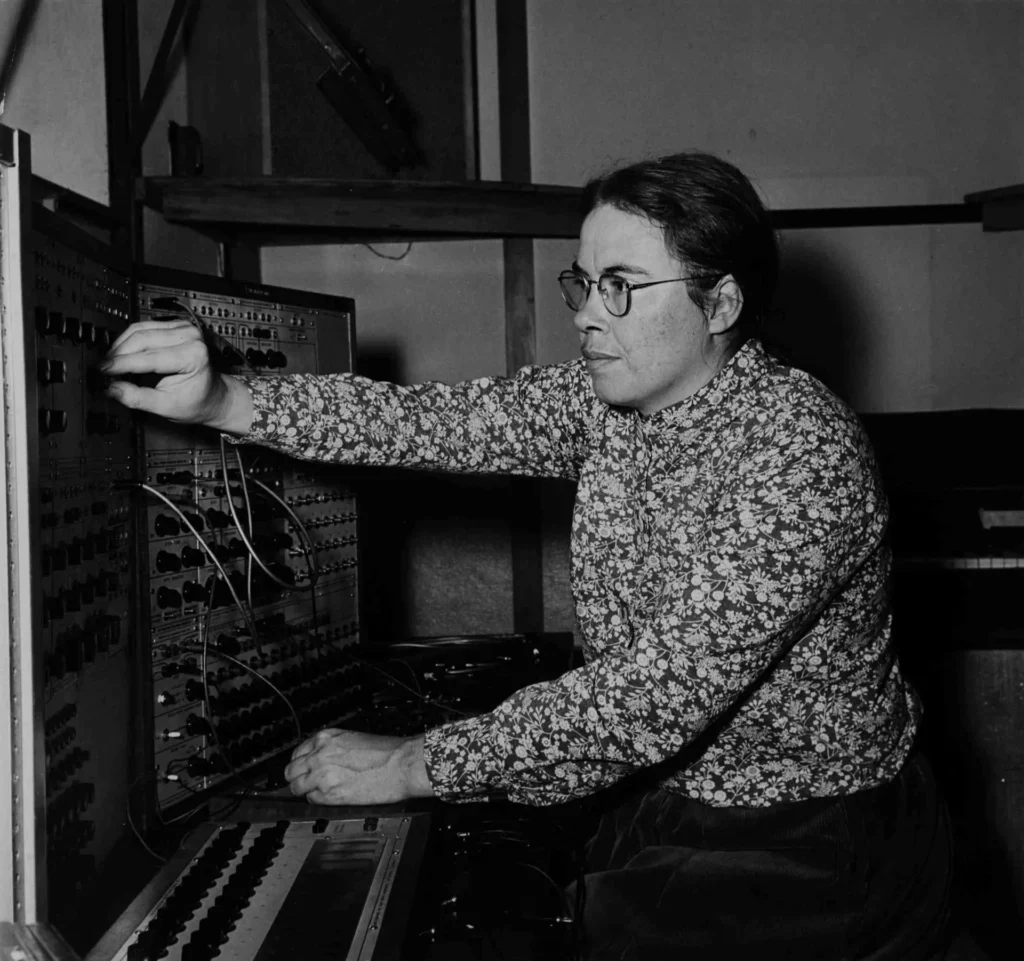
Pauline Oliveros was a central figure in electronic and tape music associated with the San Francisco Tape Music Center.
Her work frequently used analogue tape delay systems, where sound recorded onto tape is fed back into the recording system with a time offset, creating repeating echoes.
By adjusting tape speed, loop length, and feedback gain, composers could shape evolving textures and rhythmic structures, techniques that later became central to delay effects used in electronic sound production.
Q is for Shuwen Qu
Shuwen Qu is a researcher whose work explores the relationship between popular music, digital media, and technological change.
Her work situates contemporary music within the broader systems of digital communication that organise how sound is distributed, discovered, and discussed in the platform era, including a study on the vocal authority of Chinese female rock singers.
R is for Ruth Anderson
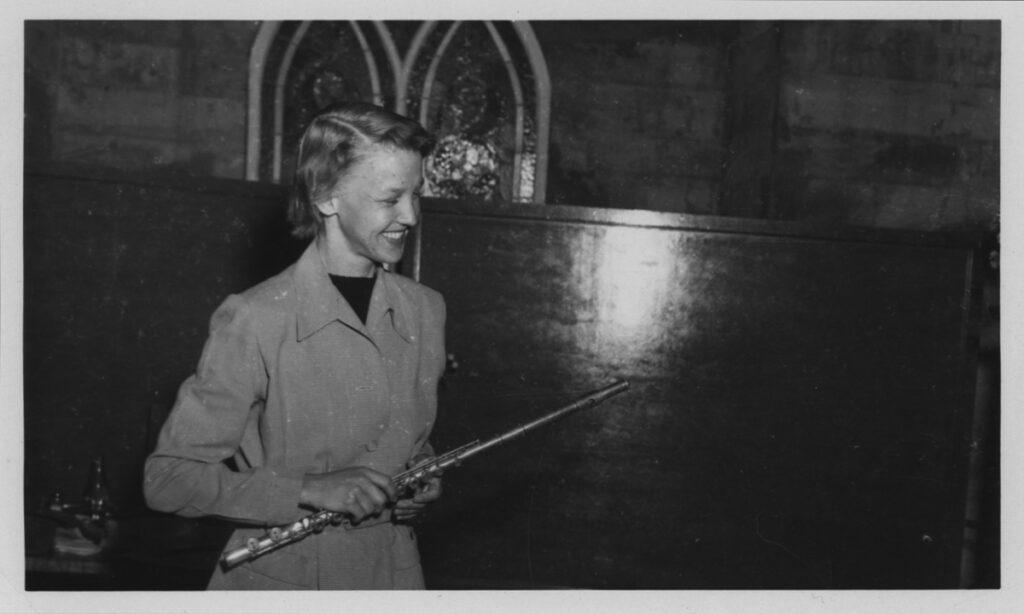
Born in 1928, Ruth Anderson was a composer and engineer who shifted from traditional orchestration to the engineering of electronic studio infrastructure and psychoacoustics.
In 1968, she designed and founded the Hunter College Electronic Music Studio. She physically engineered the lab’s architecture, calibrating early tape delay networks and integrating voltage-controlled Moog equipment.
Her subsequent research involved analysing how specific electronic frequencies and acoustic environments could physically alter human biometrics and stress levels, pioneering early biofeedback audio technology.
S is for Sophie Wilson
Sophie Wilson co-designed the ARM microprocessor architecture. ARM processors are known for their high performance and extremely low power consumption. Today they form the core architecture of most smartphones and many portable computing devices.
These processors supply the computational power required for digital synthesis, mobile audio software, and real-time music applications.
T is for Teresa Rampazzi
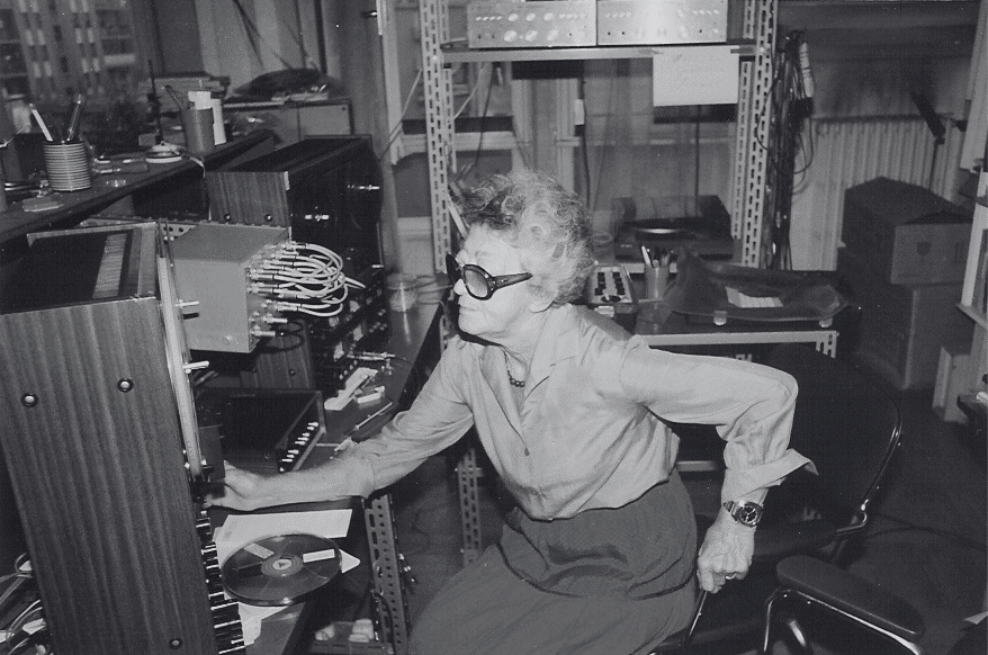
Teresa Rampazzi was among the earliest composers in Italy working with electronic and computer music.
In the 1960s, she began working with laboratory tone generators and oscillators, modifying electronic test equipment to create custom sound synthesis systems for the Nuove Proposte Sonore research group.
Her work represents one of the earliest examples of experimental electronic sound research in Italy.
U is for Ursula Mamlok
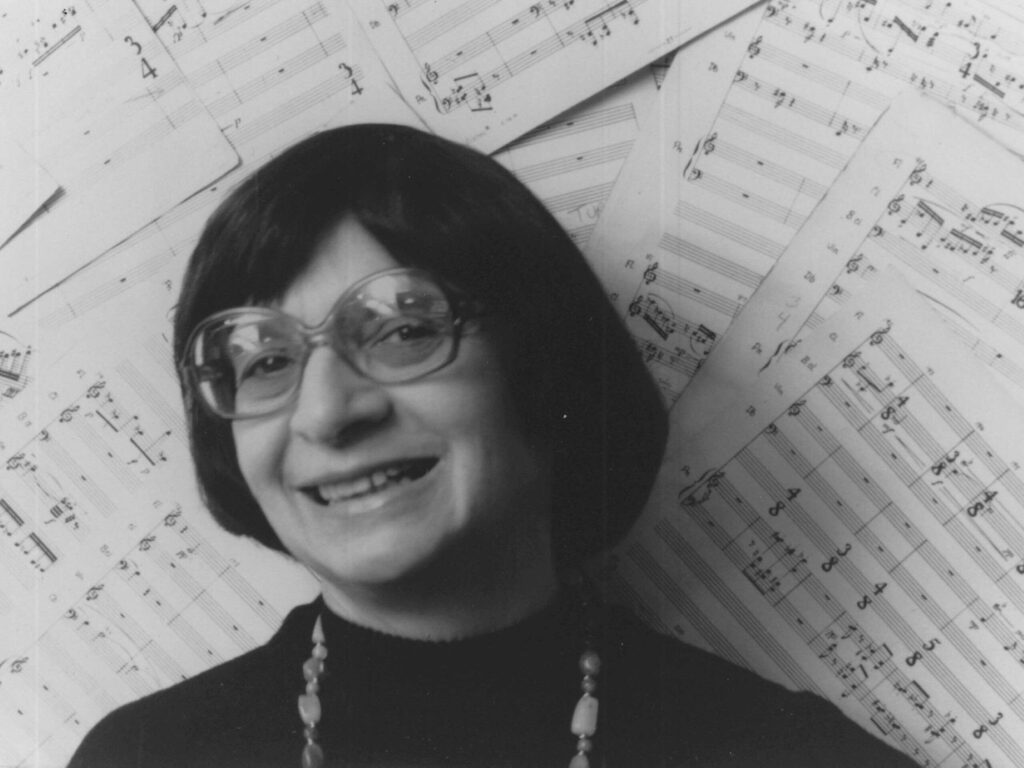
Born in Berlin in 1923, Ursula Mamlok was among the composers working with early computer-controlled electronic music at the Columbia-Princeton Electronic Music Center in the 1960s.
Her work involved the RCA Mark II Sound Synthesiser, a room-sized machine programmed using punched paper tape. Musical parameters such as pitch, duration, envelope shape, and timbre were encoded as numerical instructions.
In effect, composers were writing music as machine instructions, one of the earliest forms of algorithmic sound programming.
V is for Vera Faddeeva
Vera Faddeeva was a mathematician known for her research in numerical linear algebra. Her research contributed to computational methods used across modern scientific software. Digital audio tools rely on similar numerical techniques for signal processing, transforms, and modelling.
W is for Wendy Carlos
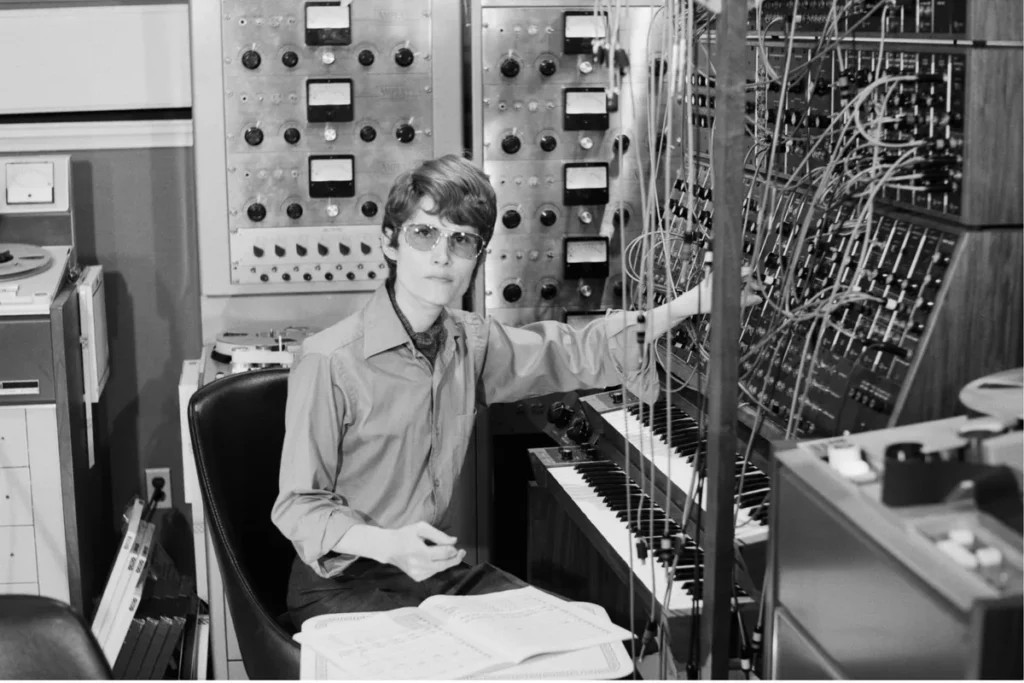
Born in 1939, Wendy Carlos is an electronic music innovator whose deep understanding of acoustic physics fundamentally shaped the commercial development of the modern synthesiser.
In the 1960s, she collaborated directly with engineer Robert Moog to refine his early modular systems. She pushed him to implement critical hardware features, including the portamento (glide) control and a touch-sensitive keyboard.
By addressing the physical interface between human biomechanics and voltage-controlled oscillators, she transformed the synthesiser from a static laboratory test instrument into an expressive musical tool.
X is for Xia Peisu
Xia Peisu was an electrical engineer and computer scientist known as the “Mother of Computer Science in China.”
She led the team that built China’s first domestically designed general-purpose electronic computer, the Model 107, in 1960.
Although not an audio researcher, the computing infrastructure she helped develop represents part of the technological foundation that later enabled digital audio processing and computer-based music systems.
Y is for Yoko Shimomura
Composer Yoko Shimomura worked extensively with the Super Nintendo Entertainment System audio hardware.
The SNES sound system used the SPC700 sound processor with 64 kilobytes of dedicated audio RAM. Music and sound effects were generated through sample playback and digital signal processing routines written specifically for the hardware constraints.
Developers had to carefully manage memory allocation and sequencing to produce complex soundtracks within these limits.
Z is for Zulema de la Cruz
Zulema de la Cruz is a Spanish composer and researcher who created LICEO, the Laboratorio de Investigación y Composición Electroacústica y por Ordenador, at the Real Conservatorio Superior de Música de Madrid in 1988.
Through LICEO, she introduced digital tools for electroacoustic composition and helped integrate computer-based sound production into conservatory training.
More letters to come
Taken together, these stories remind us that music technology has never belonged to a single discipline. It lives somewhere between mathematics, engineering, computing, sound, and music itself.
The women listed here helped shape ideas and technologies that now sit inside the systems the music world relies on. And there are many more whose names could easily fill this alphabet several times over.
For those of us working in this field today, that resonates. It means we are not starting from scratch.
Today, almost 100 women at BMAT are helping build the next layer of music copyright infrastructure, which can only mean that the alphabet is still growing.
Happy International Women’s Day.
Latest articles
March 4, 2026
BMAT Expands Collaboration with MCT Thailand to Scale VOD Royalty Processing in APAC
BMAT, a global leader in music technology and rights and royalties data, and MCT, Thailand’s collective management organisation for composers, authors, and music publishers, are expan [...]
February 23, 2026
The party we weren’t ready for until now: BMAT turned 20
On an otherwise uneventful Barcelona evening in January 2026, more than 330 people filled La Paloma, a ballroom older than most tech companies and far more accustomed to sardanes and waltze [...]
January 1, 2026
The Long Play
BMAT turns 20 this year. Such an anniversary deserves a well-thought-out post, but it’s not going to be this one. We have the feeling that 2 decades are too long a period, too long a journe [...]